


Panama Economic Growth Forecast 2026: Why IMF, World Bank, and Government Estimates Differ?
Solaya Insights
 Jane Vo
Panama’s economic growth forecast for 2026 is often presented as a single figure. In practice, it sits within a narrow range — around 4.0% from the International Monetary Fund, 3.9% from the World Bank, and close to 5% according to the Panamanian government.
At first glance, the difference appears marginal. But it raises a more relevant question: why do these estimates differ at all, if they describe the same economy?
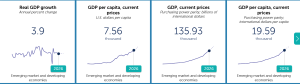
Source: International Monetary Fund (IMF)
The IMF’s projection reflects a standardized global baseline. Its forecasts are built on shared assumptions about trade flows, financial conditions, and energy markets, applied consistently across countries. Within this framework, Panama is assessed as part of a broader system. Growth, therefore, reflects what the economy can sustain under externally defined conditions, rather than country-specific momentum.
The World Bank’s estimate follows a similar approach, but with slightly more conservative calibration. Small differences in how external risks are weighted — from global demand to investment timing — can lead to marginally lower projections. The gap between 3.9% and 4.0% is not a disagreement, but a variation in how uncertainty is incorporated into the model. This more cautious stance also reflects external pressures, including geopolitical tensions in regions such as the Middle East, which are already embedded into baseline assumptions rather than treated as separate shocks.
The government’s projection, presented by Felipe Chapman at the APEDE Annual Economic Forum, reflects a different vantage point. It is based on internal visibility , including infrastructure activity, capital inflows, and sector-level recovery that may not yet be fully reflected in external models.
What separates these forecasts is not the underlying data, but the point of observation. External institutions work from the outside in. Their models prioritize consistency and comparability across economies, which often leads to stable — and deliberately cautious — growth estimates. In doing so, they tend to smooth out country-specific acceleration.
Government projections work from the inside out. They observe the economy through projects, pipelines, and fiscal dynamics as they unfold. This allows for a more immediate reading of momentum, but also introduces greater sensitivity to execution.
The difference between 3.9%, 4.0%, and 5% emerges in that space.
It is less a question of which forecast is correct, and more a reflection of what each one is designed to capture — baseline stability, risk-adjusted conditions, or execution-driven potential. What these projections ultimately reveal is not uncertainty about Panama’s direction, but clarity about its structure.
The economy is already anchored in services, logistics, and the Panama Canal — sectors that are tied to global flows rather than domestic cycles. The use of the U.S. dollar further reduces exposure to currency volatility, allowing economic activity to operate within a more stable financial framework.
In that context, growth is not being created from scratch. It is already embedded in how the economy functions. Government initiatives, including the Qualified Investor Program, operate as an additional layer. They do not define the growth trajectory, but extend it — by improving access, attracting capital, and making participation in the economy more accessible to external investors.
The difference between 4% and 5%, then, is not simply a matter of projections. It reflects how much of this underlying structure is translated into realized capital inflows. Which is why the outlook is less about whether Panama will grow, and more about how effectively it converts an already active economic base into sustained investment.