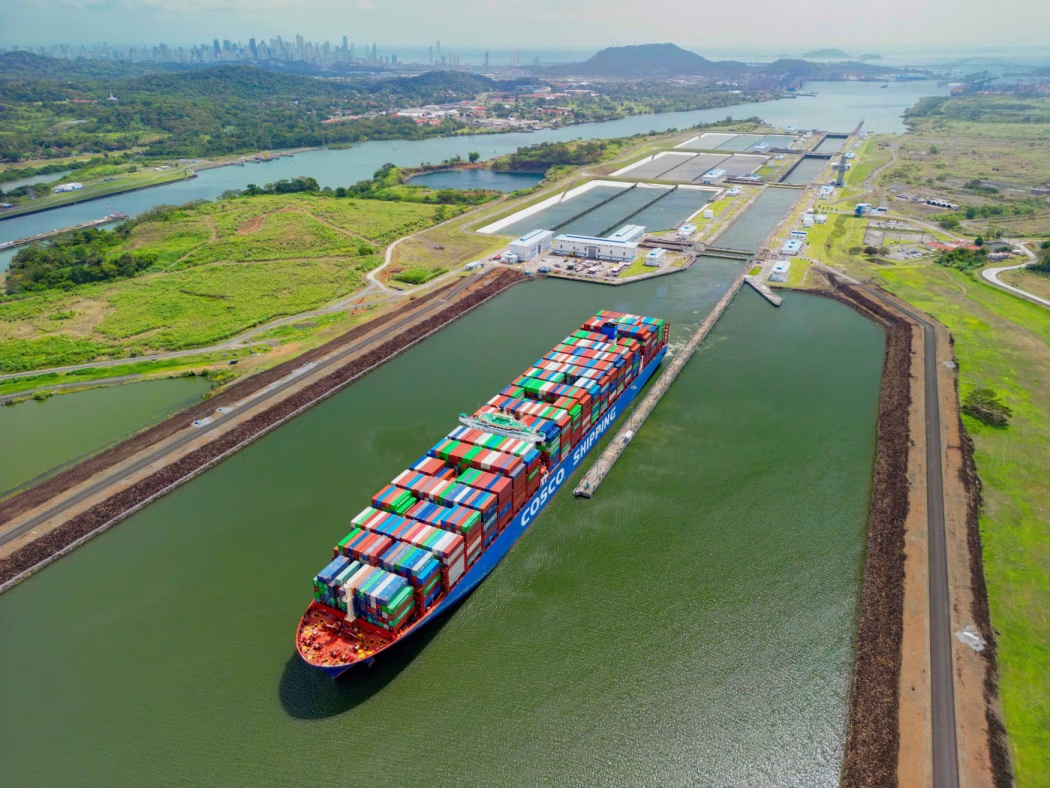


The logistics sector contributes 11.8% to Panama’s GDP, according to a report by Apede.
Logistics activity continues to position itself as one of the main pillars of Panama’s economic performance, representing 11.8% of the Gross Domestic Product (GDP) , according to the January 2026 Monthly Executive Economic Report of the Panamanian Association of Business Executives (Apede). The business sector emphasizes that the country’s logistical leadership will no longer depend solely on increased volume or operational capacity, but on structural factors such as productivity, digitalization, and institutional competitiveness against increasingly advanced regional hubs.
Apede cited data from the National Institute of Statistics and Census (INEC) showing that the GDP of logistics activity —which includes transport, storage and mail— went from $ 6,887 million in 2018 to $9,613.1 million in 2024, which is equivalent to an accumulated growth of 39.6%. During that same period, the sector’s share of the national economy increased from 10.2% to 11.8% , consolidating its structural weight in the generation of added value.
Between January and September 2025, logistics activity accumulated $ 8,367.1 million, with a year-on-year growth of 15.3%, explaining 27.8% of the increase in real GDP during that period, direct evidence of its impact on the country’s recent economic dynamism. Logistics performance was supported by port and maritime activity. In 2025, the port system handled 9,839,938 TEUs, a 3.6% increase, with 59% of the traffic concentrated in the Caribbean and 41% in the Pacific. Furthermore, 89% of operations involved transshipment, reflecting Panama’s high level of integration into global trade chains.
For its part, the Panama Canal closed Fiscal Year 2025 with 13,404 transits (+19.3%), revenues of $ 5,705 million (+14.4%) and a preliminary net profit of $ 4,134 million. Currently, between 5% and 6% of world maritime trade passes through the interoceanic waterway, which connects 180 routes, 1,920 ports and 170 countries, reaffirming its strategic role within global trade.
“Logistics is no longer just about infrastructure; it’s about productivity. Today, it contributes 11.8% to GDP and accounts for more than a quarter of recent growth. The challenge is not to move more cargo, but to reduce friction, shorten delivery times, and operate with digital efficiency and clear rules to maintain our regional leadership,” stated Giulia De Sanctis, president of Apede.
The report notes that while the sector’s value added has grown strongly, employment has shown a more moderate recovery. In 2024, 138,892 people were employed, a level similar to the pre-pandemic period, indicating greater capital intensity and operational efficiency within the sector.
Apede concludes that Panama has strategic physical assets —the Canal, ports, airport and free zones—, but the next competitive leap will depend on advancing institutional modernization, trade facilitation, digital interoperability and strengthening specialized human capital.
Cre: laestrella.com.pa